The Golden Age of Valencia
Medieval Development and Late Gothic Splendour
14th - 15th century
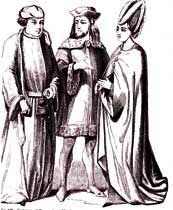 Valencia
after the Re-Conquista was somewhat of a New World. Scores of Aragonese
and Catalans kept arriving in search of a new beginning. Some of them
quickly prospered and founded powerful bourgeois lineages. The nobles
quickly followed too. All in all, this new born Christian society was
very dynamic and ambitious for its times.
Valencia
after the Re-Conquista was somewhat of a New World. Scores of Aragonese
and Catalans kept arriving in search of a new beginning. Some of them
quickly prospered and founded powerful bourgeois lineages. The nobles
quickly followed too. All in all, this new born Christian society was
very dynamic and ambitious for its times.
Many Muslims did stay, mostly producing pottery or farming the lands. Valencia also became home to a fairly large Jewish community.
The city was ruled by four Juristas, elected from the bourgeois. These were assisted by the Council, comprised of nobles, guild representatives, and the 12 parishes. In reality, however, the real power lied behind the scene, in the hands of the handful of oligarchs, usually of merchant origin, who pretty much pulled all the strings.
This system may seem as quite advanced for its time, compared to the basic feudalism, but it inevitably contained much inner conflict and struggle for power, which eventually came out ugly.
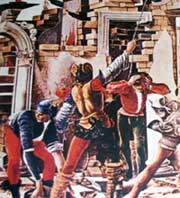
First, the Valencians backed a royal succession revolt in Aragon, prompting a severe supression by the King in 1347. A year later, Black Death swept through Valencia. In 1366, after constructing the infamous city walls, of which Torres de Serranos and Quart were part of, Valencia went to war with Castilla. Finally, the fragil Valencian social fabric gave in from so much tension and the kingdom was consumed in the fires of feuds between various power alliances. While the top were fighting between themselves, the simple folk were taking it all out on the Muslims and the Jews. Hard times brought with them a kind of religious fanaticism, of which San Vicente Ferrer - a prominent Valencian figure famous for his miracles, heavy hand of God and apocalyptic visions - was the most notable.
 When
the dust settled in 1412 with a peace accord between the feuding parties,
Valencia found that through it all it managed to experience a tremendous
economic growth due to the continuing influx of immigrants.
When
the dust settled in 1412 with a peace accord between the feuding parties,
Valencia found that through it all it managed to experience a tremendous
economic growth due to the continuing influx of immigrants.
Thus commenced the Golden Age of Valencia - its ultimate time of prosper. Throughout the XV century Valencia remained one of the major European centres, a sort of medieval New York or London. Valencia connected Europe, Africa and the Orient by trade, with various European trading factions residing here. Many of the most prominent artists and intellectuals of those times chose Valencia as their home, propelling the cultre and arts. The Borgia (of Valencian origin) in Vatican spilled their favours over the city. Valencia had become the most populous, richest and most dynamic city on the Iberian peninsula, and one of the largest cities in Europe. La Lonja was built as a symbol of this apogee.
However, this splendour was still resting on unstable social fabrics. The dynamic and cosmopolitan society of Valencia was, ultimately, its doom.


Sights from the periodLa Lonja |
Torres Serranos
| Church of
San Agustin | Palau
Generalitat | Almirante
Baths | Torres
Quart | Almudin
| Royal
Shipyards
Map: Location of Medieval
Valencia